Skip to content
The 45-Degree Problem: How to Light a Room That Slopes
- by Severn Lighting
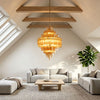
To light a sloped ceiling, use cable-hung fixtures that self-level, glowing shades that turn the slope into a reflector, and a sloped-ceiling canopy once the pitch passes about 15 degrees.
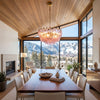
Every lighting guide assumes your ceiling is flat; the loft, attic bedroom and A-frame living room prove otherwise. Here is the geometry, with numbers.

Sloped ceiling lighting: quick reference
- Pitch up to ~15°: most standard canopies still seat flush
- Pitch 15–45°: use a sloped-ceiling adapter or swivel canopy
- Clearance: 84 in over walkways; 30–36 in above tables and islands
- Output: 2,000–3,000 lm for attic bedrooms; 3,000–4,000 lm over dining; 2700–3000K, dimmable LED
- Box rating: standard US junction box holds 50 lb; brace above that
- Best fixture types: cable pendants, chain chandeliers, all-direction glowing shades
What fixture works at what pitch?
| Ceiling pitch | Canopy needed | Fixture types that work | Avoid |
|---|---|---|---|
| Flat to 15° | Standard canopy seats flush | Flush mount, semi-flush, pendant, chandelier | Nothing |
| 15–30° | Sloped adapter or swivel canopy | Cable or chain-hung pendant, chandelier | Flush mount, rigid stem |
| 30–45° | Swivel canopy, mandatory | Cable-hung glowing shade, multi-arm chandelier | Any fixed-stem fixture |
| Over 45° / A-frame | Swivel canopy plus a long drop | Long cable pendant, wall sconces on the knee wall | Ceiling-mounted anything |
Clearance in every row: 84 in over a walkway, 30–36 in above a table or island. Output: 2,000–3,000 lm for an attic bedroom, 3,000–4,000 lm over dining, 2700–3000K dimmable LED. Bulbs not included.
Why do normal fixtures fail on a slope?
A flush mount on a 30-degree pitch aims its light at the opposite wall, not the floor. A rigid-stem pendant hangs visibly crooked against the angled plane. These are geometry failures, not lighting failures — the fix is separating the mounting plane from the light itself.

Which fixture types work best?
The long cable. A pendant on a flexible cord self-levels; gravity draws the shade plumb whatever the canopy angle — the chain-hung 2097/30 chandelier hangs true on any pitch. The wash. A paper or stone shade that glows in all directions recruits the tilted plane as a second light source — a light-toned slope returns 20–30% of perceived brightness. A wide linear piece like the Acrylic Screen Long chandelier spreads that wash across the whole pitch. The low anchor. Where slope meets knee wall, stop fighting for ceiling height: a lamp on the low side balances the tall side.


How do you measure a sloped ceiling before you buy?
- Find the highest and lowest ceiling points in the room and note both heights.
- Measure the pitch: hold a level horizontally against the slope and measure the drop over 12 inches of run. A 3 in drop is about 15 degrees; a 7 in drop is about 30 degrees; a 12 in drop is 45 degrees.
- Mark where the junction box sits relative to the table, island or bed below. On a slope the box is rarely centred over the furniture.
- Check the walkway line. Measure from the floor to where the bottom of the fixture would sit, and keep 84 inches.
- Confirm the box rating stamped inside the box, and compare it with the fixture weight.
- Order a sloped-ceiling adapter with the fixture if the pitch is over about 15 degrees. It is easier to have it and not need it.


Sloped ceiling lighting FAQ
What lights work on a sloped or vaulted ceiling?
Three geometries work reliably: cable- or chain-hung pendants (they self-level on any pitch), omnidirectional glowing shades in paper or stone that use the slope as a reflector, and low anchors — floor or table lamps under the knee wall. Rigid flush mounts aimed by the slope are the ones to avoid.
Do I need a special canopy for a sloped ceiling?
Usually yes above roughly 15 degrees of pitch. Sloped-ceiling adapters and swivel canopies typically handle up to 45 degrees; check each product page. All fixtures in our sloped collection either include one or accept one.
How low should a pendant hang in a sloped room?
Keep 84 inches (7 ft) of clearance under the lowest point over walkways. Over a table the standard 30–36 inches above the surface still applies — measure from the tabletop, not the ceiling.
How many lumens does an attic bedroom need?
Plan 2,000–3,000 total lumens from the main fixture on a dimmer, at 2700K–3000K. A light-toned slope reflects downward and can add back 20–30% of perceived brightness compared with a dark slope.
Can I put a chandelier on a sloped ceiling?
Yes — chain- or cable-hung chandeliers hang plumb from any pitch with a sloped canopy. Confirm the junction box is braced for the fixture weight (standard boxes are rated to 50 lb) and keep the lowest arm at the clearances above.
Every fixture in our Sloped Ceiling Lighting collection (140+ pieces) is cable-hung, omnidirectional or slope-canopy compatible. Free US shipping, 30-day returns. Working with stone? See our alabaster room-by-room guide.
- Posted in:
- Attic Lighting
- Buying Guide
- Pendant Lights
- Sloped Ceiling