Skip to content
An Edition of One: Reading Alabaster Room by Room
- by Severn Lighting
Alabaster is translucent gypsum stone: it diffuses LED light through natural veining, hangs 30–36 inches over tables, takes standard E26 bulbs at 2700K, and must only ever be cleaned dry.
No other lighting material shares its defining property — stone you can see through, softly, like weather. Because every slab veins differently, every fixture is an edition of one. Here is where it works hardest, room by room.

Alabaster at a glance
| Question | Answer |
|---|---|
| Material | Natural gypsum stone, translucent, unique veining per slab |
| Best rooms | Kitchen islands, dining, hallways — long-burn areas |
| Bulbs | Dimmable LED E26, 2700–3000K, CRI 90+ |
| Hang height | 30–36 in above tables and islands; 84 in over walkways |
| Care | Dry microfiber only — never water or solvents |
| Weight range | 4–40 lb by type; standard box rated 50 lb |
Where does alabaster work best?
Rooms where light stays on for hours: a kitchen island, a dining table, a hallway crossed all evening. Stone holds a middle register — bright enough to work under, warm enough to linger under — where a bare bulb tires the eyes and a plastic diffuser flattens the mood.

What is the best dining room lighting?
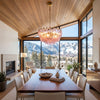
Light that flatters the people at the table. Stone diffusion wraps rather than strikes — run 3,000–4,000 lumens on a dimmer and drop to 30–50% at dinner. Three matched pendants pace a long table (one every 24–30 inches) — the Alabaster Brass pendant is the workhorse here — while one wide fixture like the Alabaster & Crystal dining chandelier suits a round one.


How do you judge quality when buying?
Three checks: shade thickness (thinner glows brighter), vein density (denser reads more classical), and stated weight versus your junction box rating. Veining reads at close range — photographs consistently undersell the material. For a first piece, the Cubic pendant shows all three checks at entry scale.


Alabaster lighting FAQ
Is alabaster lighting worth the price?
For rooms where light stays on for hours, yes. Light passes through 8–12 mm of real veined stone, so there is no hot spot and every fixture is visually unique. Expect $250–$900 depending on size and form.
What bulbs should I use in alabaster fixtures?
Dimmable LED, E26/E27 base, 2700K–3000K, CRI 90+. LED runs cool, which protects the stone; pair with a TRIAC or ELV compatible dimmer.
How do I clean alabaster?
Dry microfiber cloth only. Alabaster is gypsum-based and slightly water-soluble — water, sprays and solvents cloud it permanently. Monthly dusting is the entire routine.
How high do alabaster pendants hang over an island?
30–36 inches of clearance above the counter. Repeat matched pendants every 24–30 inches along a long island, or use one linear fixture sized to half-to-two-thirds of the island length.
Are alabaster fixtures heavy?
Wall sconces run 4–10 lb, pendants 8–20 lb, chandeliers 15–40 lb. A standard 50 lb-rated junction box covers most; check the listed weight on each product page.
Explore by form: chandeliers, pendants, table lamps, or the full alabaster collection (175 pieces). Sloped room? Read the 45-degree guide. Free US shipping, 30-day returns.
- Posted in:
- Alabaster
- Buying Guide
- Dining Room
- Kitchen Lighting