Skip to content
The Two Inches That Save a Sloped Ceiling: Adapters, Explained
- by Severn Lighting
A chandelier hangs straight on a sloped ceiling when three pieces of hardware agree: a fixture-rated junction box, a hang-straight (swivel) canopy matched to the ceiling pitch, and a chain or cord long enough to clear the low side of the slope.
We wrote before about choosing light for a room that slopes. This is the companion piece nobody writes: the two inches of metal at the ceiling that decide whether your chandelier reads as architecture or as a leaning accident.

What does the adapter actually do?
A flat-ceiling canopy assumes the box and gravity point the same way. On a pitch they disagree by the slope angle, so a rigid stem inherits the tilt. The hang-straight canopy inserts a ball joint at the box: the stem leaves the ceiling perpendicular to the slope, the joint rotates, and the fixture below hangs from a true vertical. Chain-hung pieces like the Globe Branch chandelier self-level through their links and only need the canopy plate itself to seat flush.
Which spec matters at which pitch?
| Ceiling pitch | Roof equivalent | Hardware needed |
|---|---|---|
| Under 15° | up to 3/12 | Standard canopy, chain or cord hang |
| 15° to 30° | 3/12 to 7/12 | Hang-straight swivel canopy |
| 30° to 45° | 7/12 to 12/12 | Swivel canopy + extended stem or chain on the low side |
| Over 45° | steeper than 12/12 | Heavy-duty 60° adapter, electrician-braced box |
How do you install one?
- Measure the pitch. Rise over run, converted to degrees. A 6/12 pitch is 27°.
- Check the box. Fixture-rated boxes carry 50 lb; braced or fan-rated boxes carry 70 to 150 lb. Weigh the fixture before trusting the box.
- Fit the swivel canopy so the joint articulates down the slope, and route the wire with a drip loop.
- Level and lock. Hang the piece, let it settle plumb, lock the joint, and check with a level across the lowest tier.

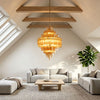
One honest caveat: an adapter solves geometry, not judgment. A fixture that fights a slope visually, wide and flat under a steep pitch, still fights it when hung plumb. Rounder, tiered silhouettes such as the Magnolia multi-tiered chandelier forgive the angled backdrop best.
Sloped ceiling chandelier mounting: your questions
What is a sloped ceiling adapter for a chandelier?
A sloped ceiling adapter, also called a hang-straight or swivel canopy, is a mounting fitting that sits between the junction box and the fixture. Its ball-and-socket or hinged joint lets the stem leave the ceiling at an angle while the chandelier itself hangs perfectly plumb.
Do all chandeliers need an adapter on a sloped ceiling?
Chain-hung and cord-hung fixtures usually self-level and only need a canopy that seats flush on the slope. Rigid-stem fixtures always need an adapter once the pitch passes about 15 degrees, because a rigid stem transfers the ceiling angle straight to the fixture.
What ceiling pitch can a hang-straight adapter handle?
Most adapters articulate up to 45 degrees, and heavy-duty versions reach 60. Measure your pitch first: rise over run converted to degrees. A typical 6/12 roof pitch is about 27 degrees, well inside the range of any standard adapter.
Can I install a sloped ceiling adapter myself?
If a rated junction box already exists, fitting an adapter is a straightforward continuity of the same wiring job and takes under an hour. Fixtures over 50 lb or boxes that need bracing between rafters are an electrician visit, not a weekend project.
How much weight can a sloped ceiling mount hold?
The limit is the junction box, not the adapter: a standard ceiling box rated for fixtures carries 50 lb, and a fan-rated or braced box carries 70 to 150 lb. Match the box rating to the fixture weight before any hardware goes up.
- Posted in:
- Buying Guide
- Installation
- Sloped Ceiling