Skip to content
Brass and Flame: A Colour Story for Warm Interiors
- by zhanglei
A Colour Story
Brass and Flame: A Colour Story for Warm Interiors
Every warm room has a source. In a candle-style chandelier it is a row of small upright flames — not a single bright disc overhead, but eight or ten separate points of amber, each one sitting in glass and metal that pass the colour on. The wall behind them decides what you actually see.
A candle flame is not white light. It is amber, it is uneven, and it comes from a point rather than a plane — which is why a room lit by several small flames feels different from the same room lit by one bright fixture, even at identical brightness. Faces are modelled instead of flattened. Corners stay soft. The eye is given something to rest on.
Brass is simply the metal that agrees with that light. Below: what candle light does to three different wall colours, and what to look at up close.
One lamp lights a room. Ten small flames give it a mood.
What candle light does
• Splits the output into many small points, so shadows stay soft instead of hard
• Sits at eye level in the fixture, which is what makes a room feel occupied
• Reflects off every piece of glass and metal near it, multiplying itself
• Changes character with the wall behind it — the same flame, three rooms
What it is not
• Not task lighting — it sets the tone, a lamp does the reading
• Not the same as one big bulb behind a shade, however warm that bulb is
• Not flattering under cool metal — chrome and nickel drain the amber out
• Not fixed at the factory — the bulb you fit decides the final warmth
Three walls, three moods

Warm white walls
The flames become the only colour
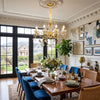
Against warm white there is nothing to compete with, so the eye goes straight to the flames. Four small uprights inside each cage, repeated three times down the island — twelve points of amber in a room that is otherwise pale from floor to ceiling.
This is candle light at its most graphic. Because the walls give nothing back, the light does not build up into a glow; it stays as points, and the glass cage draws a shadow pattern around each one.
The trade-off is that daylight wins here. Until the sun drops, this room is lit by its windows and the chandeliers are sculpture — which is exactly why the frame is worth looking at.
Soft cream walls
The flames fill the whole room
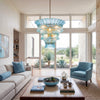
Cream walls return warm light instead of absorbing it, so every flame is effectively doubled — once as itself, once as the glow it throws back off the plaster. At dusk the room reaches an even warmth that no single fixture could produce.
Clear crystal is the right partner in this scheme. Each drop catches a flame and repeats it, so ten bulbs read as fifty small highlights, without adding a colour of their own to the mix.
One cool note keeps it honest: a dark timber table, black window frames, navy velvet. Something for the amber to sit against.


Deep navy walls
The flames become the room
Dark walls absorb rather than reflect, so the light stops travelling and stays where it is made. What you get is a bright cluster at the centre and a room that falls away into shadow — the closest a wired fixture comes to real candlelight.
This is where coloured crystal belongs. Green drops tint the light as it passes through, cooling it just enough to read against navy, while the flames above stay amber and keep the whole thing warm.
It is also the most dramatic shift between day and night. By daylight the room is quiet and the chandelier is jewellery; after dark it becomes the only thing you look at.
Pale walls scatter the flame. Dark walls keep it. Neither is wrong — they are different rooms.
Look closer at one candle
A single arm on a candle chandelier is four separate decisions, and each one changes how the flame reads from across the room.

The flame tip. A drawn glass point instead of a rounded end — it reads as a flame at a glance, not as a bulb.

The candle cup. A slim sleeve raises the flame clear of the arm so the point of light sits high and unobstructed.

The bobeche. Fluted glass beneath each candle catches the light falling off it and sends a ring of highlights back up.
The spacing. Arms held apart so no flame hides behind another — you count them all from any seat.
Building the palette
Choose the bulb shape before the wall colour
A flame-tip bulb keeps the candle reading as a candle. A rounded golf-ball bulb turns the same fixture into a row of small lamps — a different look entirely, for the price of a bulb.
Put it on a dimmer
Candle-style fixtures are the ones that gain most from dimming. At full output they light the room; at a third they become the room, and the crystal starts doing the work instead of the bulbs.
Choose the crystal after the wall
Clear crystal suits pale rooms, where a second colour would crowd the scheme. Coloured crystal belongs on dark walls, where it has room to be seen.
Questions people ask about candle chandeliers
+What is a candle chandelier?
A chandelier that carries several exposed upright bulbs on individual arms, in place of a single shaded source. The form comes from real candle branches, and the reason it survived electrification is optical: many small points of light model a room more softly than one bright one, at the same total output.
+What bulbs go in a candle chandelier?
A slim candle bulb with a candelabra base — E12 in the US, E14 in Europe. Flame-tip versions have a drawn glass point and read most like a real flame; rounded versions look more like small lamps. Bulbs are not included with our fixtures, so the shape and warmth are yours to choose.
+Are candle chandeliers bright enough to light a room?
Together, yes — a six to ten light fixture puts out plenty. But the light arrives spread out and directional rather than focused, so keep a table lamp for reading. Think of a candle chandelier as the light that sets the mood, with task lighting layered under it.
+Does brass lighting work with white walls?
Yes, and it is one of the easiest pairings. Against warm white the metal supplies all the warmth in the scheme and the flames become the only points of colour. Cool or blue-leaning whites are harder — they make brass look yellow rather than golden.
+Should I choose clear or coloured crystal?
Match it to the wall rather than to the metal. Clear crystal keeps pale rooms uncluttered and repeats each flame without adding a second colour. Coloured crystal — green, amber, smoke — needs a dark or richly coloured background to read properly.
SevernLighting
Bring the flame into your room
Solid brass frames, hand-set crystal, and candle-style light — made for rooms where the colour of the light matters.
Browse all chandeliers- Posted in:
- bedroom lighting
- brass chandelier
- candle chandelier
- crystal chandelier
- dining room lighting
- interior colour palette
- lighting ideas
- warm interiors